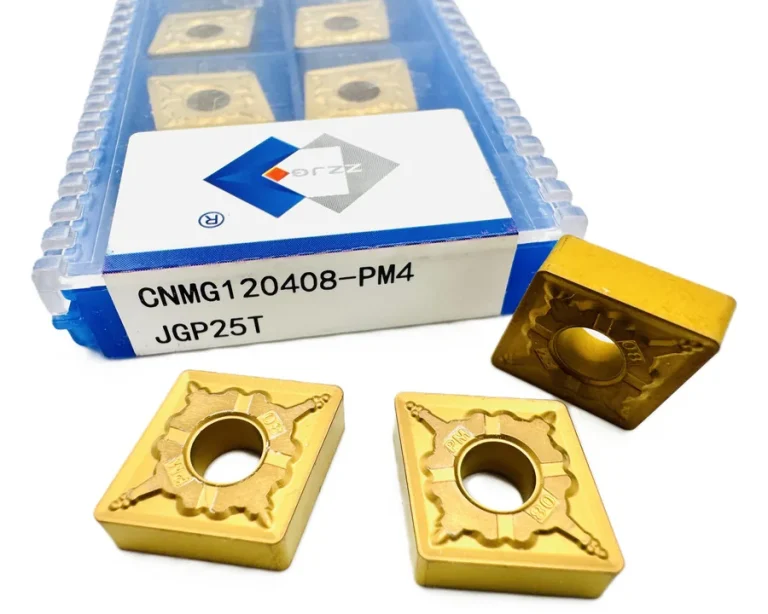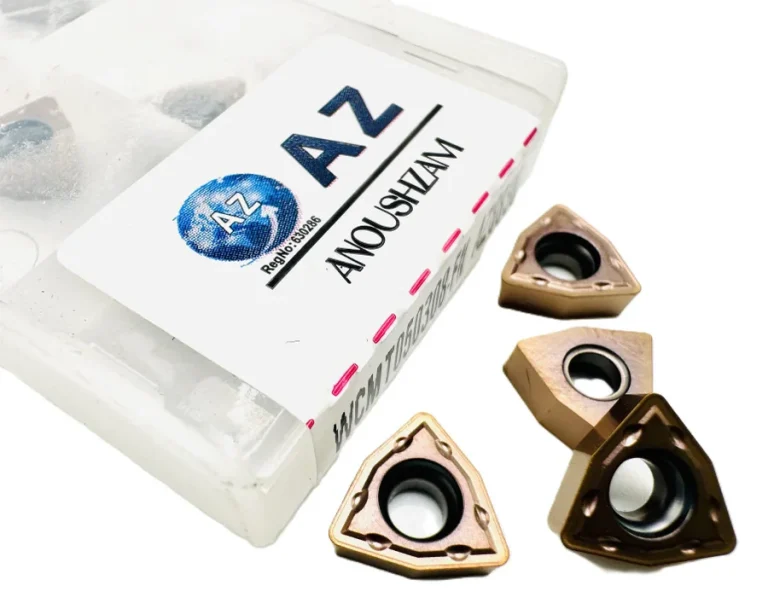

The code on an insert box is more than a product name: it is part of the shared language used by tool drawings, holders and purchasing. However, reading the first four letters is not enough for a final selection. Two inserts marked CNMG120408 can differ in grade, edge preparation and chipbreaker and need not perform identically in a particular job. This guide turns the code into practical questions to check before buying.
A workshop “diamond” is not necessarily diamond
A tool called “diamond” in workshop conversation may be a coated-carbide insert rather than a PCD tool. Carbide, cermet, ceramic, CBN and sintered diamond are separate material families; Mitsubishi’s introduction to tool materials shows this distinction. State the cutting material and grade clearly in a purchase enquiry so a colloquial term does not lead to the wrong material.
What do the four CNMG letters tell you?
| Position | Meaning in this family | Practical check |
|---|---|---|
| C | Rhombic shape with an 80-degree included angle | Seat shape and access to the component profile |
| N | Zero nominal clearance angle; negative family | Holder compatibility and mounted geometry |
| M | Insert dimensional tolerance class | Use the manufacturer’s table; it is not a “medium part accuracy” rating |
| G | Hole and double-sided chipbreaker arrangement | Clamping method and exact insert drawing |
See the code structure and tolerance meaning in Mitsubishi’s insert-identification lesson. The G arrangement is also described in Kennametal’s designation table. Zero insert clearance does not mean every effective angle of the mounted cutting tool is zero.
Read the numbers as size codes
For the metric example CNMG120408, do not assume “12” means a 12 mm diameter or “04” a 4 mm thickness. One verified Mitsubishi example has the following dimensions:
| Code section | Example dimension |
|---|---|
| 12 | 12.7 mm inscribed circle |
| 04 | 4.76 mm thickness |
| 08 | 0.8 mm nose radius |
These values come from Mitsubishi’s CNMG120408 table. For an actual order, check the complete product number and its drawing; visual similarity is not a reliable method of converting metric and inch designations.
Keep the grade and chipbreaker in the enquiry
The grade specifies the cutting material and its characteristics; the chipbreaker relates to chip formation and control. Suffixes and grade names are not necessarily equivalent between manufacturers. If an existing tool performs well, keep a clear photograph of the whole box label, rather than only CNMG. Compare every proposed alternative against the workpiece material, hardness and operation.
Finishing geometries are designed for lighter cuts, while roughing geometries support heavier loads. Using them in the wrong application can cause chipping, rubbing or poor chip control; Sandvik’s explanation of turning geometries describes this relationship. Match selection to the depth-of-cut and feed chart for that chipbreaker, rather than insert colour or price alone.
Holder and workshop matching checklist
- Record the full holder code, seat, shim and clamping system.
- Check insert shape, size, thickness and nose radius.
- Specify the workpiece alloy, hardness and surface condition.
- State whether the cut is continuous or interrupted and identify grooves.
- Define roughing, semi-finishing or finishing and the required result.
- Include tool overhang, workholding and coolant conditions in the review.
- Record trial results and the wear pattern before series production.
Mechanical fit is only part of selection. Sandvik’s external-turning guide also considers clamping, entering angle and access to the component shape together.
Short answers
Are matching CNMG codes from two brands guaranteed substitutes?
No. Dimensions and seat fit must match, and grade, chipbreaker and cutting data also need review. The same base code does not guarantee the same performance.
Does a larger nose radius always give a better finish?
The choice depends on profile, feed and assembly stability. Do not substitute a larger number without checking corner restrictions and cutting conditions.
Explore the inserts in this catalog. In your insert quotation request, include a label photograph, holder code and workpiece information so the proposal can be checked against your application.
Technical references
Manufacturer references for the points discussed; product selection still requires the current data for the exact tool.
- Mitsubishi Materials — Kinds of tool materials
- Mitsubishi Materials — Insert turning identification code
- Kennametal — Insert designation reference
- Mitsubishi Materials — ISO Turning Inserts, B214G
- Sandvik Coromant — Turning Geometry: Finish, Medium, Rough
- Sandvik Coromant — External turning
Practical selection checks
Verify the complete CNMG code against the exact maker’s chart. Grade and chipbreaker selection depend on material, operation, machine stability and chip control. Check the seat, clamp and orientation before trialing a substitute.
Browse the industrial tool catalog or send a technical enquiry.
Additional selection checks
Verify the complete CNMG code against the maker’s chart. Grade and chipbreaker depend on material, operation and machine stability. Confirm the insert seat and holder, and compare substitutes in a controlled trial.
Browse the industrial tool catalog or send a technical enquiry with the exact code and application.
Use this guide for initial understanding and comparison. For operating limits, safety and exact settings, follow the manual and datasheet for the specific tool model and your workplace procedures.