
When a tool wears quickly, buying a “harder material” is not a complete answer. The issue may involve cutting-material compatibility, entry impact, edge preparation or clamping. PCD, CBN and coated carbide are not simply three names for more expensive and cheaper versions of the same tool; each has its own application range and selection conditions. Start with the workpiece material and condition, then compare the actual production cost.
What do these three names mean?
PCD means polycrystalline diamond, while PCBN refers to polycrystalline cubic boron nitride; the shorter name CBN is also common in technical discussion. Do not confuse these materials with a coating on carbide. In coated carbide, the substrate and coating act together to determine tool behaviour. Mitsubishi’s coating lesson explains the distinction between substrate and coating and the CVD and PVD processes.
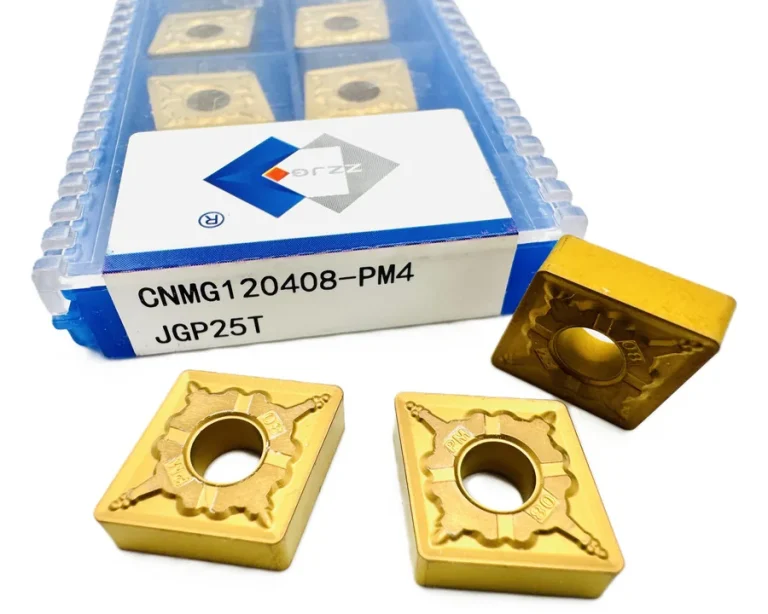
Hardness is only one criterion; toughness and the ability to tolerate the cutting conditions also matter. Mitsubishi’s tool-material classification helps explain the distinction. An insert’s gold or dark appearance does not reliably identify its material, grade or application; ask for the code and manufacturer information.
An initial comparison of the material families
| Family | Initial application area to investigate | Deciding question |
|---|---|---|
| PCD | Non-ferrous materials such as aluminium alloys and some abrasive non-metallic materials | Does the exact grade cover your workpiece and operation? |
| CBN / PCBN | Hardened steel and specific cast-iron and sintered-material applications | Do hardness, cut type and edge preparation match that grade’s guidance? |
| Coated carbide | A wide range of operations with the appropriate substrate, coating and geometry | Is the grade recommended for this alloy, load and process stability? |
This comparison draws on Mitsubishi’s CBN and PCD grade introduction and Seco’s guide to turning materials and grades. The table is not permission to use every tool in a family on every material in that row.
Keep three application scenarios separate
An aluminium component: Record the alloy, cast or wrought condition, finish requirement and production volume. PCD can be worth investigating, but the word aluminium alone does not establish that it is necessary. First ask why the existing tool needs replacing and what quality is required. Suitable carbide can meet some applications, while others need a specialist solution reviewed.
Hardened steel: Specify actual hardness and the hardened layer, and describe whether the cut is continuous or interrupted. CBN has dedicated grades for this field, but no single grade covers every condition. Mitsubishi’s CBN application table separates recommendations by workpiece, cutting mode and grade. Do not automatically replace a steel-cutting tool with PCD merely because it is called diamond.
Mixed production with different cuts: Before moving to a specialist material, record the performance of an appropriate carbide grade. If components, quantities or operations frequently change, an economic comparison is misleading without knowing the share of each job. Different operations may require more than one tool family; one box does not have to cover everything.
Clamping and cutting conditions still matter
A specialist material does not automatically compensate for a damaged seat, incorrect clamping or an unsuitable program. Obtain edge preparation, cut continuity, coolant method and starting data from the particular product’s guidance. The range described in Seco’s advanced-material introduction shows why grade selection matters even within PCBN. Do not apply one generic spindle speed or feed to all these tools.
Turn box price into cost per acceptable component
For a comparison trial, define one operation and use the same end-of-life criterion. Record usable edges, acceptable components per edge, changeover time, quality-control time and scrap. Then divide the cost by the number of acceptable components. A claim of “several times longer life” is insufficient without the material, test conditions and end-of-life criterion. Do not extend one successful trial to a different component without testing.
Prepare these details for an enquiry
- Alloy, hardness and heat-treatment condition
- Drawing or operation dimensions and required tolerance or finish
- Holder, clamping and whether the cut is continuous or interrupted
- Current cutting data, coolant method and a photograph of tool wear
- Batch size, end-of-life criterion and required manufacturer documentation
Short answers
Is a more expensive tool always more economical?
No. Cost per acceptable component and downtime matter. A higher price does not prove a better result without a comparable trial.
Can CBN grades be substituted based only on insert shape?
No. Matching shape is insufficient; grade, edge preparation and the application range must be confirmed for your conditions.
Explore the cutting tools in the catalog and send the checklist information to request a suitable cutting material and grade.
Technical references
Manufacturer references for the points discussed; product selection still requires the current data for the exact tool.
- Mitsubishi Materials — Coating
- Mitsubishi Materials — Kinds of tool materials
- Mitsubishi Materials — CBN and PCD turning inserts
- Seco Tools — A Guide to Turning Grades, Materials and Solutions
- Mitsubishi Materials — CBN application tables
- Seco Tools — Advanced Cutting Materials
Practical selection checks
Compare PCD, CBN and coated carbide for a defined material, operation and acceptance criterion. Record usable edges, changeover, good parts and downtime. Use the exact grade guidance and avoid generalizing one trial.
Browse the industrial tool catalog or send a technical enquiry.
Additional selection checks
Compare PCD, CBN and coated carbide for a defined alloy, operation and acceptance criterion. Record usable edges, good parts, changeover and downtime. Follow the exact maker guidance for the grade.
Browse the industrial tool catalog or send a technical enquiry with the exact code and application.
Use this guide for initial understanding and comparison. For operating limits, safety and exact settings, follow the manual and datasheet for the specific tool model and your workplace procedures.