
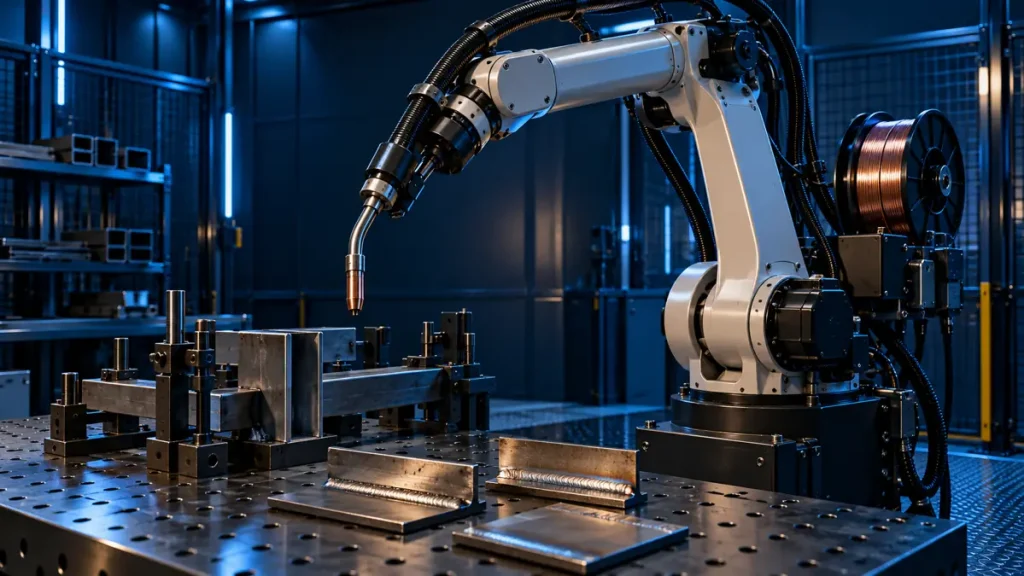
Industrial automation advice should begin with the production problem, not a robot model. Before purchase, define the part family, weld quality criteria, output target, operator workflow and who is responsible for integration.
Start with the process and product mix
List part drawings and revisions, material, joint type, weld length and variation. Explain how parts are loaded, located and removed. A cell that suits one stable part may not suit frequent changeovers or mixed production.
Eight questions to resolve
- Which operation is the bottleneck and how is downtime measured?
- What is the real product mix and batch size?
- What cycle time and quality criteria must be met?
- How repeatable are parts, fixtures and incoming fit-up?
- Where will the robot, torch, power source and safety equipment fit?
- What utilities, extraction and access are required?
- Which controller, welding source and factory systems must interface?
- Who designs, installs, validates, trains and supports the cell?
Separate equipment supply from integration
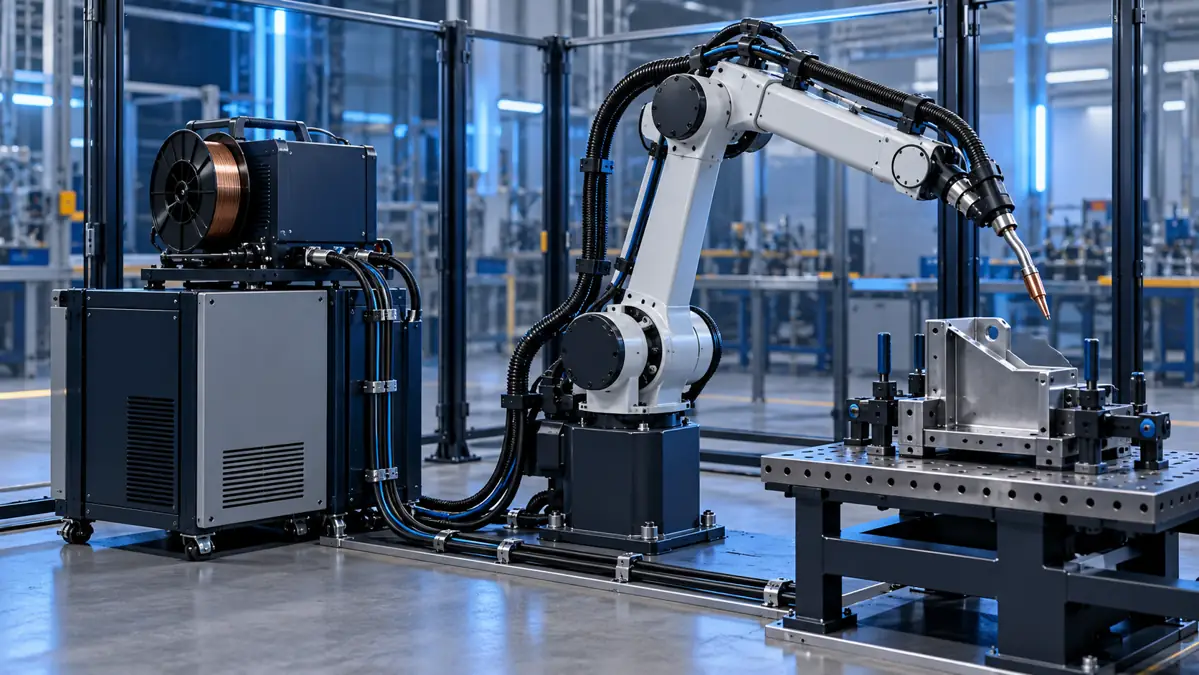
Robot, welding source, torch, wire feeder, fixture, sensors and guarding work as a system. A supplier quotation should identify what is included and excluded. Installation, programming, safety review and production acceptance need a named qualified integrator and a written scope.
Make a measurable business case
Compare the baseline and proposed process using the same assumptions: cycle time, changeover, rework, uptime, staffing and maintenance. Include commissioning time, consumables, training and spare parts. Treat estimated savings as estimates until a pilot or acceptance test confirms them.
How Anoush Zam can support an enquiry
Anoush Zam can help structure the technical requirements and review equipment sourcing options. The company has about two and a half years of commercial activity and draws on around forty years of machining experience. Those facts support informed conversations about production needs; they do not by themselves certify robot integration or guarantee project performance. Confirm the engineering, installation and safety responsibilities in the written proposal.
Assessing a robotic welding cell
Industrial automation consultation should start with the real production cycle, not a robot’s nominal payload or reach. Record sample parts, fixtures, the welding process, manual time and stoppages. Map a simple baseline: an operator loads a part, the robot welds, quality checks the result and the next part enters. This sequence can show whether the constraint is actually welding or instead preparation, handling, cooling, inspection or part supply.
For an initial comparison, collect the part drawing and material, thicknesses and joint type, weld position and length, process and consumables, product mix, shift volume, current cycle time, rework rate, ventilation and installation space. The information need not all be complete before the first discussion; mark unknowns so they do not silently become assumptions in a cost estimate.
- Reach and path: reach is more than arm length. Review torch angle, fixture collisions, cable routing, weld position and torch-service access.
- Part and fixture repeatability: part tolerances, location repeatability, loading access and possible loading errors can affect weld quality.
- Integration: machine signals, PLC interfaces, welding equipment, fume extraction, guards, interlocks and emergency stops belong in the system design.
- Product changes: compare model count, fixture changeover and operator training with the expected volume. A cell for stable high-volume work may not suit low-volume mixed orders.
- Maintenance and support: include consumables, torch parts, nozzles, wire and repair support in ownership cost and downtime planning.
Do not calculate payback by replacing only manual welding time. Include loading, fixtures, inspection, model changeovers, stops, repair and accepted-part rate. Present the result with real shift data and an uncertainty range; a firm estimate before a process review, site survey and safety assessment is not reliable. Good industrial automation consultation also states which work is equipment supply and which requires design, installation or an integrator’s responsibility.
Assign an owner to each decision before purchase: welding or process engineering, safety, maintenance, production and the integrator should review the proposal. Write down responsibilities, acceptance criteria, handover documents, training and commissioning. If the fixture, required output or inspection method is unresolved, stage the purchase decision until those inputs are known.
Industrial robot safety reference
The official page for ISO 10218-1:2025 introduces safety requirements for the industrial robot itself. A complete cell also needs an application-specific risk review covering end effectors, workpieces, welding hazards and integration, alongside applicable local rules and a qualified safety specialist. Citing this standard does not mean a company or specific product is certified. In industrial automation consultation, clarify the safety-assessment scope and which documents must come from the manufacturer or integrator.
Implementation scope and integrator responsibility
Separate a proposal into four work packages: the robot and welding source; end effector, fixture and table; safety and auxiliary equipment; and programming, installation and commissioning. For each proposal, identify what is priced, what the customer must supply and what remains out of scope. In particular, state who owns fixture design, fume extraction, guards and interlocks, connection to existing machines, acceptance testing and operator training.
For an initial industrial automation consultation, ask the contractor to state its assumptions: part type, product mix, target cycle time, expected availability, shifts, changeover time and accepted-part criteria. Review a less favourable scenario too: what if incoming parts vary, the torch needs service or a fixture is out of position? These questions do not rule out automation; they make cost and risk visible before an order.
Define the handover package before signing: layout drawings, electrical and pneumatic documents, robot program version, spare-parts list, recovery procedure, maintenance instructions, safety-test records and acceptance criteria. The documentation must fit the project and installation rules. A successful commissioning is more than robot motion; operators need to know normal status, emergency stops, consumable replacement and how to request support.
If the goal is lower cost, compare a robot with fixture improvement, part standardization, a different welding method or outsourcing one operation. On some lines the constraint is preparation or handling, and a robot alone merely moves the bottleneck. Industrial automation consultation should measure the problem and compare viable options; the final choice follows technical, safety, commercial and service review.
Write acceptance criteria before installation
A complete industrial automation consultation should make handover more precise than “the robot works.” Define acceptance around the product and cycle: which joints are welded, what dimensions or quality indicators apply, which inspection method is used, how many samples are checked and who signs the report. If weld quality requires a destructive or non-destructive test, agree on the method and owner in the project scope; do not select a test from a general web guide.
| Stage | Evidence or result | Decision owner |
|---|---|---|
| Before design | Drawing, sample part, process, product mix and baseline cycle | Production and engineering |
| Before cell build | Layout, fixture, material flow, loading points and hazard zone | Integrator and safety lead |
| Before handover | Representative-part trial, documents, backup program and training | Customer and process owner |
| After commissioning | Downtime, quality, consumables, service and cycle stability data | Production and maintenance |
For an industrial automation consultation, ask the supplier to identify handover documents and out-of-scope items before ordering. The difference between a low and high quotation may be peripherals, installation, training or documentation rather than the robot model. Compare proposals in one table with the same assumptions; separate construction, installation, installation downtime, consumables and support where applicable.
During execution, record drawing or material changes by revision and send significant changes for process review. Robot programs, weld parameters and safety settings need a named owner and version. Obtain a backup copy and recovery procedure at handover. A useful industrial automation consultation leaves production with reusable outputs: assumptions, responsibilities, acceptance criteria and unresolved work.
When several suppliers are involved, appoint one coordinator for the robot, welding equipment, fixture, ventilation and existing machinery. Integration between these elements must be reviewed before production release; split responsibilities without an overall owner can leave issues moving between vendors. Record unresolved hazards, document due dates, training and support terms at design reviews. These details make industrial automation consultation trackable beyond selecting equipment.
Frequently asked questions
Can a robot automate every welding job?
No. Part consistency, access, joint preparation, fixture design, production mix and safety all affect feasibility.
Does a robot quotation include installation?
Only if installation, programming, commissioning and acceptance are explicitly included in the quotation.
What should I send for an initial review?
Share drawings, material, joint details, part family, expected output, current cycle and site constraints. Remove confidential details that are not needed.
This is a planning guide, not an engineering or safety approval. A qualified project team must assess the actual workcell, risk controls and applicable requirements.
Acceptance criteria for a welding cell
Before purchase, write observable acceptance criteria for each requirement. These may include an agreed sample part, weld appearance and dimensions against the product drawing, target cycle time, fixture repeatability, permitted downtime, fault logging and process-parameter traceability. Your quality and engineering teams must set acceptance levels for the actual application; no generic number applies to every part and standard.
Separate mechanical delivery from commissioning, programming, operator training and post-installation support in the scope. Assign responsibility for samples and consumables, electrical and layout drawings, spare-parts lists, operator-interface language, program backups and service response. When equipment comes from multiple suppliers, name one integrator responsible for interface coordination and final testing.
Before approving the order
- Review cell layout and operator and maintenance access.
- Have qualified personnel complete the risk assessment and guarding plan.
- Define fault, emergency-stop and safe restart scenarios.
- Assign owners and records for factory and site acceptance tests.
- Include training, consumables and post-delivery support in the scope.
A useful industrial automation consultation produces more than a robot list and price: project assumptions, constraints and success criteria must also be documented. For an initial review, prepare the joint type, part family, volume, current cycle time, available floor space and product variation. Final welding-cell selection depends on an on-site engineering and safety assessment.
Use this guide for initial understanding and comparison. For operating limits, safety and exact settings, follow the manual and datasheet for the specific tool model and your workplace procedures.