Choosing a pneumatic impact wrench involves more than selecting the largest torque figure. A tool that looks powerful in a catalog must also suit the joint, socket, working space and local air supply. For industrial purchasing, consider the wrench and its air installation as one system. This guide prepares the information needed to compare models; the pressure, hose or specifications of one model cannot be prescribed for every tool.
Define the job before the drive size
Removing a seized fastener during maintenance differs from tightening a critical production joint. Describe the task, fastener dimensions and condition, access and usage duration. Then compare drive size, weight, body length, direction controls and the declared noise and vibration data. Drive size alone does not establish power or suitability. Chicago Pneumatic’s impact-wrench selection guide
Do not treat torque figures as interchangeable
Working torque, maximum torque and the figure stated for loosening may have different labels and test conditions. Request the same characteristic under comparable conditions from the manufacturer. An impact wrench builds torque through successive impacts, and both air pressure and impact duration affect the result. Atlas Copco’s technical introduction to impact wrenches
Airflow and pressure are separate questions
Check the pressure recommended for the exact model, and distinguish pressure at the tool inlet while operating from the reading at the receiver. The tool’s position in the network and restrictions along the route affect the air it receives. Raising pressure is not the default remedy for poor performance, and the tool’s permissible limit must not be exceeded. Chicago Pneumatic’s guide to power and torque control
For airflow, request the units, reference conditions and basis of the declared figure: average consumption or consumption while operating? Compressor delivery, simultaneous use of other tools and the work pattern also matter. Receiver capacity cannot replace air-production and consumption data. Generic figures are only initial estimates; the selected model’s manufacturer data takes priority. Compressed-air requirement assessment guide
| Required information | Question to answer |
|---|---|
| Drive and retainer | Are the socket and its retention system compatible with the tool output? |
| Torque | Which operating mode and test conditions does the figure describe? |
| Operating pressure | What are this model’s recommended pressure and permissible limit? |
| Air consumption | Are the value, units and average or operating basis stated? |
| Air route | Have length, internal diameter, fittings and pressure drop been assessed? |
| Environment and operator | Are access, weight, noise, vibration and working method suitable? |
Do not select the hose from the inlet thread size
The inlet thread does not determine the hose’s internal diameter. Route length, airflow, couplings and the air-preparation unit contribute to pressure drop. Check the manufacturer’s recommendation and the actual installation’s losses; one diameter or pressure is not suitable for everything. Filtration and lubrication must also match the tool instructions. Atlas Copco’s air-tool installation guide
Sockets and accessories are part of the selection
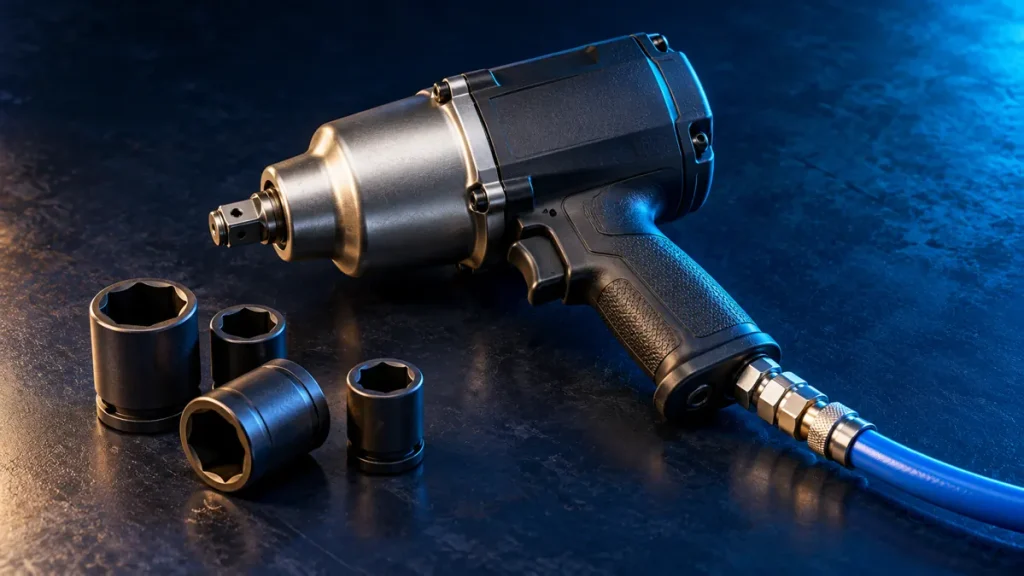
Select a sound impact-rated socket with compatible dimensions and retention; appearance alone is not sufficient. A hand socket is not an approved substitute for this application. Choose extensions and adapters for compatibility with the assembly too; adding adapters can change impact transmission. Impact-socket guide and Chicago Pneumatic safety instructions
Before changing accessories, adjusting or servicing, isolate and depressurize the compressed-air supply safely according to the model instructions. Use that tool’s pressure limits, component compatibility and maintenance program; one model’s instructions do not authorize applying its specifications to another brand or model. An example of Atlas Copco product instructions
Fast tightening does not verify final torque
Where a joint requires a specified torque, define the tightening and verification method with appropriate equipment according to the assembly instructions. The sound of impacts or a numbered power setting does not certify that the target has been reached. A torque wrench clicking after overtightening does not, by itself, reveal that previous excess torque. Guide to tightening technique
What should your enquiry include?
- Application, fastener and access restrictions
- Required torque characteristic and verification method
- Existing drive, sockets and accessories
- Compressor model and delivery-capacity information
- Route length, hose internal diameter and fittings
- Simultaneous users, work pattern and required tool quantity
Short answers
Will a more powerful tool solve an air-supply problem?
No. First check whether delivered airflow and pressure meet the model’s requirements; higher rated power does not compensate for insufficient incoming air.
Is every black socket impact-rated?
Do not rely on color. Match the manufacturer’s specification, approved application, size and socket-retention method.
Can I infer a TOKU wrench’s specifications from the brand name?
No. The precise model code and datasheet are needed. Without them, do not assign a particular pressure, air consumption or torque figure.
Explore our pneumatic tools and impact-wrench page, then send your installation details for a sourcing enquiry.
Practical selection checks
Breakaway torque does not guarantee controlled installation torque. Match the drive and air supply to the exact datasheet. Use the approved final torque method for critical fasteners.
Browse the industrial tool catalog or send a technical enquiry.
Additional selection checks
Breakaway torque does not establish controlled installation torque. Match the drive, pressure and airflow to the exact tool datasheet. Use the approved method for final torque on critical fasteners.
Browse the industrial tool catalog or send a technical enquiry with the exact code and application.
Use this guide for initial understanding and comparison. For operating limits, safety and exact settings, follow the manual and datasheet for the specific tool model and your workplace procedures.